Boost 共通テスト 英語リーディング2023年度
2023年度・追再試験

共通テスト英語 2023年度(令和5年度) 追再試験 第4問
本文と解答解説

問題を解いたら、意味のまとまりごとに本文を読み直しましょう。

1

問題PDF

2

全文訳

Our Garden Plan

Daniel Hi! Daniel here! I scanned this great planting chart in a gardening book I got from the library. The black circles show when to plant seeds directly into the soil. The black squares show when to plant seedlings, which are like baby plants. The stars show when to harvest a vegetable.

Planting Schedule

Month columns: Mar. | Apr. | May | June | July | Aug. | Sept. | Oct. | Nov. beans | — | ● ● | ● | — | ☆ ☆ | — | — | — | — cabbages | ● | ● | — | — | ☆ ☆ | ■ | ■ | ☆ | ☆ ☆ carrots | ● | ● | — | — | ☆ ☆ | — | — | — | — onions | — | — | ☆ | ☆ ☆ | — | — | ● ● | — | — potatoes | ● ● | — | — | ☆ ☆ | — | ● | — | — | ☆ ☆ tomatoes | — | ● ■ | ■ | — | ☆ | ☆ ☆ | — | — | —

私たちの庭づくり計画

Daniel こんにちは!Danielです!図書館で借りた園芸の本に載っていた、このすばらしい栽培表をスキャンしました。黒い円は、種を土に直接まく時期を示しています。黒い四角は、苗、つまり幼い植物のようなものを植える時期を示しています。星印は、野菜を収穫する時期を示しています。

栽培予定表

月の欄:3月 | 4月 | 5月 | 6月 | 7月 | 8月 | 9月 | 10月 | 11月 豆類 | — | ● ● | ● | — | ☆ ☆ | — | — | — | — キャベツ | ● | ● | — | — | ☆ ☆ | ■ | ■ | ☆ | ☆ ☆ にんじん | ● | ● | — | — | ☆ ☆ | — | — | — | — たまねぎ | — | — | ☆ | ☆ ☆ | — | — | ● ● | — | — じゃがいも | ● ● | — | — | ☆ ☆ | — | ● | — | — | ☆ ☆ トマト | — | ● ■ | ■ | — | ☆ | ☆ ☆ | — | — | —

Daniel It’s already late March, so I think we should plant the potatoes now. We can harvest them in June, and then plant them again in August. Also, I’d like to plant the carrots at the same time as the potatoes, and the cabbages the next month. After harvesting them in July, we can put in cabbage seedlings at the same time as we plant the onions. We won’t be able to eat our onions until next year! I have bought tomato seedlings and would like to give them more time to grow before planting them. Let’s plant the beans toward the end of April, and the tomatoes the following month.

Daniel もう3月下旬なので、今じゃがいもを植えるべきだと思います。6月に収穫し、それから8月にもう一度植えることができます。また、じゃがいもと同じ時期ににんじんを植え、翌月にキャベツを植えたいと思います。7月にそれらを収穫した後、たまねぎを植えるのと同じ時期にキャベツの苗を植えることができます。たまねぎを食べられるのは来年になってからです!トマトの苗は買ってあり、植える前にもっと成長する時間を与えたいと思っています。4月下旬ごろに豆類を植え、翌月にトマトを植えましょう。

Daniel Let’s discuss the garden layout. We will have a 6 × 6 meter area and it can be divided into two halves, north and south. Beans, cabbages, and tomatoes grow above the ground so let’s grow them together. How about in the southern part? We can grow the carrots, potatoes, and onions together because they all grow underground. They will go in the northern part.

Daniel 庭の配置について話し合いましょう。6×6メートルの区画があり、それを北と南の2つの半分に分けることができます。豆類、キャベツ、トマトは地上で育つので、一緒に育てましょう。南側はどうでしょうか。にんじん、じゃがいも、たまねぎはすべて地下で育つので、一緒に育てることができます。それらは北側に置きます。

Re: Our Garden Plan

Rachel Thanks, Daniel!

Rachel Rachel here. Your schedule is great, but I’d like to make some changes to your garden layout. We have six vegetables, so why don’t we divide the garden into six sections?

Rachel We have to be careful about which vegetables we plant next to one another. I did a little research in a gardening book about the vegetables we’ll grow. Some of our vegetables grow well together and they are called “friends.” Others don’t and they are “enemies.” Our layout must consider this.

件名:私たちの庭づくり計画

Rachel ありがとう、Daniel!

Rachel Rachelです。あなたの予定はすばらしいですが、庭の配置を少し変更したいと思います。野菜は6種類あるので、庭を6つの区画に分けてはどうでしょうか。

Rachel どの野菜を隣り合わせに植えるかには注意しなければなりません。育てる野菜について、園芸の本で少し調べました。私たちの野菜の中には、一緒に育てるとうまくいくものがあり、それらは「友だち」と呼ばれています。そうでないものは「敵」です。配置にはこのことを考慮しなければなりません。

Rachel First, the tomatoes should go in the southern part of the garden. Tomatoes and cabbages are enemies and should be separated. Let’s plant the cabbages in the southwest corner. The onions can be put in the middle because they are friends of both tomatoes and cabbages.

Rachel まず、トマトは庭の南側に置くべきです。トマトとキャベツは敵なので、離しておくべきです。キャベツは南西の角に植えましょう。たまねぎはトマトとキャベツの両方の友だちなので、中央に置くことができます。

Rachel Next, let’s think about the northern part of the garden. Let’s put the beans in the western corner because beans and cabbages are friends. Carrots are friends with tomatoes so planting them in the eastern corner would be better. Potatoes can go in the middle. They are friends with beans and neutral with onions.

Rachel Well, what do you think of the layout?

Rachel 次に、庭の北側について考えましょう。豆類とキャベツは友だちなので、豆類を西の角に置きましょう。にんじんはトマトの友だちなので、東の角に植えるのがよいでしょう。じゃがいもは中央に置けます。じゃがいもは豆類の友だちで、たまねぎとは中立です。

Rachel さて、この配置をどう思いますか。

Re: Re: Our Garden Plan

Hi!

It’s me! Thanks for your excellent ideas! Below is the planting schedule Daniel suggested two days ago. First, we need to buy [24] kinds of seeds soon so we can plant them over the next two months!

Mar. | [A] potatoes Early Apr. | [B] Late Apr. | [C] May | [D] Aug. | potatoes Sept. | onions; cabbages

件名:Re: 私たちの庭づくり計画

こんにちは!

私です!すばらしいアイデアをありがとう!以下は、Danielが2日前に提案した栽培予定表です。まず、これから2か月の間に植えられるように、すぐに[24]種類の種を買う必要があります!

3月 | [A] じゃがいも 4月上旬 | [B] 4月下旬 | [C] 5月 | [D] 8月 | じゃがいも 9月 | たまねぎ;キャベツ

I made this garden layout using Rachel’s idea.

北側と南側に3区画ずつある6区画の庭。北西[I]、北中央[II]、北東[III]、南西[IV]、南中央[V]、南東[VI]と表示され、North・South・West・Eastの方位が示されている。

It is similar to Daniel’s. The vegetables in the northern and southern halves are almost the same. Only the [27] are in different areas.

Rachelのアイデアを使って、この庭の配置を作りました。

これはDanielの配置と似ています。北側と南側の半分にある野菜はほとんど同じです。異なる場所にあるのは[27]だけです。

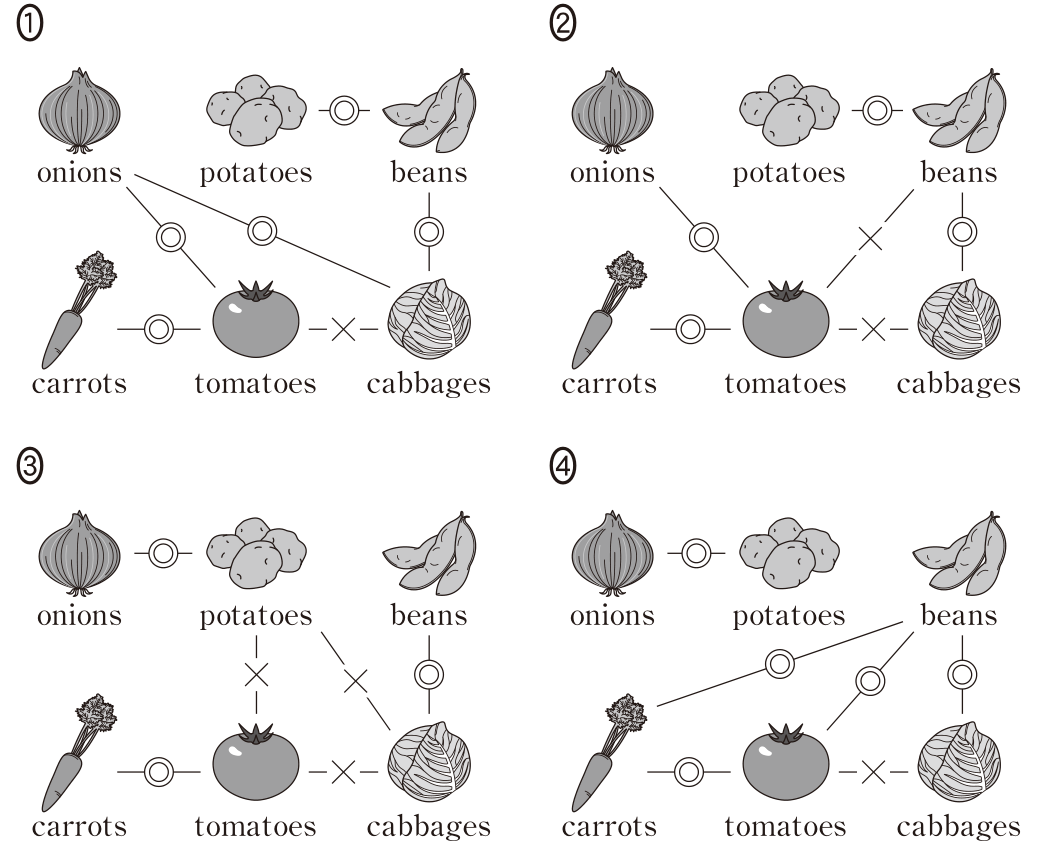
Rachel did a good job of considering friends and enemies. For our reference, I have made a chart.

たまねぎ、じゃがいも、豆類、にんじん、トマト、キャベツの相性 chartを入れる空欄。

We have not yet discussed [29], but I think we should.

Rachelは、友だちと敵を考慮して、よい仕事をしました。参考のために、表を作りました。

私たちはまだ[29]について話し合っていませんが、話し合うべきだと思います。

Which chart should appear in [28]?

(◎ : friends, × : enemies)

[28]にはどの表を入れるべきですか。

(◎:友だち、×:敵)

Choose the best option for [29].

① the difference between seeds and seedlings ② the responsibilities of caring for the garden ③ the timing for collecting the crops ④ vegetables that should be planted together

[29]に入る最も適切な選択肢を選びなさい。

① 種と苗の違い ② 庭の世話をする責任 ③ 作物を収穫する時期 ④ 一緒に植えるべき野菜

3

解答解説

設問 1 の解答・解説

Choose the best option for ____.

訳

[24]に入る最も適切な選択肢を選びなさい。

原文の“I have bought tomato seedlings”から、tomatoesについては苗をすでに購入済みだと分かります。したがって、これから用意する種の種類は、tomatoesを除く4種類です。空欄24の選択肢では、数値4に当たるchoice 2を選びます。

選択肢を比べる

1. 3

訳

3

数値3では、tomato seedlings以外の4種類を1種類数え落とします。

2. 4

○ 正解
訳

4

tomatoesは苗を購入済みなので、これから買う種は4種類です。

3. 5

訳

5

数値5では、tomatoesを含めて5種類の種を買う計算になります。

4. 6

訳

6

数値6では、6種類すべてを種から準備することになりますが、tomatoesは苗です。

設問 2 の解答・解説

Complete the planting schedule in your email. Choose the best option for ____.

訳

メールの栽培予定表を完成させなさい。[25]に入る最も適切な選択肢を選びなさい。

予定表の空欄は、本文の植え付け順と時期を照合します。表ではMarchのpotatoesに続き、Early Apr.がcarrots、Late Apr.がcabbages、Mayがbeans、Aug.がtomatoesとなります。したがって[A]〜[D]はcarrots、cabbages、beans、tomatoesで、choice 3です。

選択肢を比べる

1. [A] cabbages; [B] carrots; [C] beans; [D] tomatoes

訳

[A] キャベツ;[B] にんじん;[C] 豆類;[D] トマト

Aをcabbages、Bをcarrotsとしており、carrotsとcabbagesの表上の時期が逆です。

2. [A] cabbages; [B] carrots; [C] tomatoes; [D] beans

訳

[A] キャベツ;[B] にんじん;[C] トマト;[D] 豆類

Late Apr.にtomatoes、Mayにbeansを置いており、beansを4月末、tomatoesをその後に植える順序と逆です。

3. [A] carrots; [B] cabbages; [C] beans; [D] tomatoes

○ 正解
訳

[A] にんじん;[B] キャベツ;[C] 豆類;[D] トマト

A=carrots、B=cabbages、C=beans、D=tomatoesで、予定表の各時期に対応します。

4. [A] carrots; [B] tomatoes; [C] cabbages; [D] beans

訳

[A] にんじん;[B] トマト;[C] キャベツ;[D] 豆類

Early Apr.にtomatoes、Late Apr.にcabbagesを置いており、tomatoesを翌月に植える条件と合いません。

設問 3 の解答・解説

Complete the garden layout information in your email. Choose the best option for ____.

訳

メールの庭の配置に関する情報を完成させなさい。[26]に入る最も適切な選択肢を選びなさい。

Rachelの指定を図に入れると、北側は西からbeans、potatoes、carrots、南側は西からcabbages、onions、tomatoesです。したがって[I]〜[VI]はbeans、potatoes、carrots、cabbages、onions、tomatoesとなり、choice 2です。

選択肢を比べる

1. [I] beans; [II] onions; [III] tomatoes; [IV] cabbages; [V] potatoes; [VI] carrots

訳

[I] 豆類;[II] たまねぎ;[III] トマト;[IV] キャベツ;[V] じゃがいも;[VI] にんじん

南側中央をpotatoesとしており、onionsを中央に置く条件と異なります。

2. [I] beans; [II] potatoes; [III] carrots; [IV] cabbages; [V] onions; [VI] tomatoes

○ 正解
訳

[I] 豆類;[II] じゃがいも;[III] にんじん;[IV] キャベツ;[V] たまねぎ;[VI] トマト

北西beans・北中央potatoes・北東carrots、南西cabbages・南中央onions・南東tomatoesとなり、指定どおりです。

3. [I] cabbages; [II] onions; [III] carrots; [IV] beans; [V] potatoes; [VI] tomatoes

訳

[I] キャベツ;[II] たまねぎ;[III] にんじん;[IV] 豆類;[V] じゃがいも;[VI] トマト

北西をcabbages、南西をbeansとしており、北西beans・南西cabbagesという指定を逆にしています。

4. [I] cabbages; [II] potatoes; [III] tomatoes; [IV] beans; [V] onions; [VI] carrots

訳

[I] キャベツ;[II] じゃがいも;[III] トマト;[IV] 豆類;[V] たまねぎ;[VI] にんじん

北側中央と南側中央の野菜を入れ替えており、potatoesとonionsの位置が逆です。

設問 4 の解答・解説

Choose the best option for ____.

訳

[27]に入る最も適切な選択肢を選びなさい。

Danielは、地上で育つbeans・cabbages・tomatoesと、地下で育つcarrots・potatoes・onionsをそれぞれ同じ区域にまとめました。Rachel案では、beansは北西、onionsは南中央に置かれるため、Daniel案と異なる区域に移ります。選択肢ではbeans and onionsに当たるchoice 1です。

選択肢を比べる

1. beans and onions

○ 正解
訳

豆類とたまねぎ

beansはDaniel案の地上野菜側からRachel案の北側へ、onionsは地下野菜側から南側へ移ります。

2. cabbages and potatoes

訳

キャベツとじゃがいも

cabbagesは南西に細かく配置されますが、Daniel案とRachel案で大きな区域が変わる野菜の組ではありません。

3. carrots and tomatoes

訳

にんじんとトマト

carrotsは地下野菜側、tomatoesは地上野菜側で、両者が別の区域へ移ったわけではありません。

4. onions and potatoes

訳

たまねぎとじゃがいも

onionsは異なる区域に移りますが、potatoesは北側中央に残るため、組み合わせ全体が該当しません。

設問 5 の解答・解説

Which chart should appear in ____? (◎ : friends, × : enemies)

訳

[28]にはどの表を入れるべきですか。(◎:友だち、×:敵)

野菜同士のfriendsとenemiesの関係を示す4つの選択肢図①〜④。

本文で明示された関係を整理すると、beans-cabbages、beans-potatoes、carrots-tomatoesはfriends、tomatoes-cabbagesはenemiesです。また、onionsはtomatoesとcabbagesのfriendで、potatoesとはneutralです。これらの線と記号を正しく示すのはchart 1、choice 1です。

選択肢を比べる

1. ①

○ 正解

tomatoes-cabbagesをenemy、beans-cabbages、beans-potatoes、carrots-tomatoesをfriendとして示し、本文の関係に対応します。

2. ②

beans-tomatoesをenemyとしており、本文がenemyと述べるのはtomatoes-cabbagesです。

3. ③

potatoes-cabbagesやpotatoes-tomatoesをenemyとしており、本文にない敵対関係を加えています。

4. ④

carrots-beansなど、本文で関係が指定されていない組み合わせをfriendとして示しています。

設問 6 の解答・解説

Choose the best option for ____.

訳

[29]に入る最も適切な選択肢を選びなさい。

最後の文は“We have not yet discussed ___, but I think we should.”です。本文では種・苗の意味、植え付け時期、収穫時期、配置、野菜同士の相性がすでに扱われています。一方、誰が庭の世話を担当するかという分担は出ていないため、choice 2を選びます。

選択肢を比べる

1. the difference between seeds and seedlings

訳

種と苗の違い

種と苗の違いは、Danielが黒丸と黒四角の説明で既に扱っています。

2. the responsibilities of caring for the garden

○ 正解
訳

庭の世話をする責任

庭の世話を誰が担当するかは、メール中でまだ説明されていません。

3. the timing for collecting the crops

訳

作物を収穫する時期

収穫時期はPlanting Scheduleの星で示され、Danielの説明にも含まれています。

4. vegetables that should be planted together

訳

一緒に植えるべき野菜

一緒に植える野菜はDanielの区域案とRachelのfriendsの説明ですでに話題になっています。

4

読み方のポイントまとめ

この大問では、Daniel・Rachel・あなたの三人が、コミュニティーガーデンで育てる6種類の野菜について、植え付け時期、収穫時期、区画の配置、野菜同士の相性をメールで相談します。前半では、黒丸・黒四角・星の意味を区別して予定表を読み、後半では、北半分・南半分の区分と各区画の位置を整理します。さらに、本文に書かれたfriends(相性がよい野菜)とenemies(相性が悪い野菜)を図の記号と照合し、最後にまだ話し合われていない事項を判断します。時期・位置・相性を別々の表に整理すると、複数のメールをまたぐ情報も正確に処理できます。

  • Danielのメール冒頭で、黒丸は種を直接まく時期、黒四角は苗を植える時期、星は収穫時期だと確認します。記号を混同せず、野菜ごとに予定を整理します。
  • next month、the following month、after harvestingなどの相対表現は、基準となる月を明らかにして具体的な月へ置き換えます。
  • 配置問題では、まず北側・南側を決め、次に西・中央・東の区画へ野菜を入れます。Rachelの指定を図の[I]〜[VI]と順に対応させます。
  • 相性 chart は、本文に明示された組み合わせだけを拾い、friend・enemyの線を照合します。本文に書かれていない関係を推測して補わないことが重要です。
  • 最後の空欄では、メール全体で既に扱われた内容を消去し、まだ具体的に話題になっていない事項を選びます。

間違えやすいポイント

黒丸・黒四角・星をすべて植え付け時期として読むと、種・苗・収穫の区別を失います。
表の凡例を先に確認し、各野菜についてseed、seedling、harvestを別々に整理してください。

next monthやthe following monthを、文中の直前の野菜に機械的に結びつけると時期を逆にしやすいです。
相対表現の基準となる月を確認し、March、Early Apr.、Late Apr.、Mayのように時系列へ置き換えます。

北側・南側という大きな区域と、西・中央・東の個別区画を混同しやすいです。
まず北半分と南半分を決め、その後に各半分の西・中央・東を埋めてください。

本文に明示されていない野菜同士の関係を、図の見た目から推測しやすいです。
chartでは本文に書かれたfriend・enemyだけを記号と照合し、情報のない組み合わせは追加しません。

次の問題にも使える読み方

相対表現を具体的な時期へ戻す
same time、next month、the following monthなどを、基準となる出来事と結び付けて時系列表に変換します。
例:“the following month”は、直前に示された月の翌月として読みます。

大分類から細部へ読む
位置問題では、全体の区域、方角、中央・角の順に条件を固定します。最初から6区画を同時に覚えようとしないことが有効です。
例:“southwest corner”は、南側にある西端の区画として処理します。

明示情報だけで関係図を作る
相性や因果関係の問題では、本文に明示された組み合わせを箇条書きにしてから図へ移します。
例:“Tomatoes and cabbages are enemies”なら、その1本の線だけを×にします。

既出情報を消去して未出事項を探す
メールの最後に話題を問われたら、本文中に既に説明された候補へ印を付け、残った選択肢を確認します。
例:収穫時期が表にある場合、庭の世話の分担が未出ならその候補を検討します。

5

重要語句

rent a section of a community garden
コミュニティーガーデンの一区画を借りる
planting chart
植え付け表
plant seeds directly into the soil
種を直接土にまく
seedling
苗
harvest
収穫する
planting schedule
植え付け予定表
toward the end of April
4月末頃に
the following month
翌月
give them more time to grow
それらをより長く育てる時間を与える
garden layout
庭の配置
be divided into two halves
二つの半分に分けられる
above the ground
地上で
underground
地下で
next to one another
互いに隣り合って
do a little research
少し調べる
grow well together
一緒によく育つ
be separated
離して配置される
southwest corner
南西の角
in the middle
中央に
in the western corner
西側の角に
in the eastern corner
東側の角に
neutral with
〜とは中立の関係である
responsibilities of caring for the garden
庭の世話の分担