Boost 共通テスト 英語リーディング2023年度
2023年度・追再試験

共通テスト英語 2023年度(令和5年度) 追再試験 第6問
本文と解答解説

問題を解いたら、意味のまとまりごとに本文を読み直しましょう。

1

問題PDF

2

全文訳

Getting to Know Aquatic Species

The mysteries of the deep blue sea have fascinated ocean-watchers for millennia. Aquatic beings, however, cannot easily get to us. What if we go to them? Despite what you may expect, certain ocean animals will come right up to you. Dan McSweeney, a Hawaii-based underwater research photographer, tells a fascinating story. While he was studying whales underwater, one came charging at him. Whales are huge, so he was worried. The whale stopped, opened its mouth, and “passed” him some tuna. He accepted the gift. McSweeney believes that because of the air bubbles coming from his tank, the whale recognized him as a similar animal and offered the sashimi. Later, the whale came back, and McSweeney returned the food.

Friendly interactions with dolphins or whales are possible, but how about octopuses? Science fiction sometimes describes aliens as looking like octopuses, so this animal group “cephalopods,” which means “head-feet,” may be perceived as being distant from humans. Yet, if you learn more about them, you might be convinced there is the possibility of interaction. Octopuses have long tentacles (arms/legs) extending from soft round bodies. Besides touch and motion, each tentacle experiences smell and taste and has sucking disks, called suckers, that grab and manipulate things. Their eyes, like two independent cameras, can move 80° and focus on two different things at once. UC Berkeley researcher, Alexander Stubbs, confirms that while octopuses sense light and color differently from humans, they do recognize color

changes. These features might indicate that they are intelligent enough to interact with us. In fact, an article in Everyday Mysteries begins: “Question. Can an octopus get to know you? Answer. Yes.”

水生生物を知る

深い青い海の謎は、何千年もの間、海を見つめる人々を魅了してきた。しかし、水生生物のほうから私たちのところへ来ることは簡単ではない。では、私たちが水生生物のところへ行くのはどうだろう。予想とは異なり、近寄ってきてくれる海の動物もいる。Hawaiiを拠点とする水中調査写真家のDan McSweeneyが、興味深い話をしている。水中でクジラを調査していたとき、1頭のクジラが彼に向かって突進してきた。クジラは巨大なので、彼は不安になった。そのクジラは立ち止まり、口を開け、マグロを彼に「手渡した」。彼はその贈り物を受け取った。McSweeneyは、タンクから出る気泡のために、そのクジラは彼を同種の動物だと認識し、刺身を差し出したのだと考えている。その後、そのクジラは戻ってきたので、McSweeneyは食べ物を返した。

イルカやクジラとの友好的な交流は可能だが、タコについてはどうだろうか。サイエンスフィクションでは、宇宙人がタコのような姿で描かれることがある。そのため、「頭足(head-feet)」を意味するこの動物群は、人間とはかけ離れたものだと受け取られるかもしれない。しかし、タコについてさらに学べば、交流できる可能性があると納得するかもしれない。タコには、柔らかく丸い体から伸びる長い触手(腕・脚)がある。触覚と動きだけでなく、それぞれの触手はにおいと味を感じ、物をつかんで操作する吸盤を備えている。タコの目は2台の独立したカメラのように、80度動かすことができ、一度に異なる2つの物に焦点を合わせられる。UC Berkeleyの研究者であるAlexander Stubbsは、タコは人間とは異なる方法で光と色を感じるものの、色を認識することを確認している。

変化。これらの特徴は、タコが私たちと交流できるほど知的であることを示しているのかもしれない。実際、Everyday Mysteriesの記事は次のように始まる。「質問。タコはあなたを知るようになれるか。答え。はい。」
Octopuses are known to “return your gaze” when you look at them. They may even remember you. This notion was tested by Roland C. Anderson and his colleagues, who conducted experiments with two similar-looking people wearing the same uniforms. The friendly person, who had fed and socialized with them, got a completely different reaction from the cephalopods than the other person who had not.

When taken from their natural habitat, octopuses can be mischievous, so watch out. They can push the lids off their tanks, escape, and go for a walk. Scientists sometimes get surprise visits. A paper from the Naples Zoological Station, written in 1959, talks about trying to teach three octopuses to pull a lever down for food. Two of them, Albert and Bertram, cooperated with the experiment, but Charles, a clever cephalopod, refused to do so. He shot water at the scientists and ended the experiment by breaking the equipment.

タコは、こちらが見つめると「視線を返す」ことで知られている。こちらのことを覚えていることさえあるかもしれない。この考えは、同じような外見の2人が同じ制服を着て行った、Roland C. Andersonと同僚による実験で検証された。タコに餌を与え、交流していた親しみやすい人物に対して、頭足類は、そうしていなかったもう一人の人物とはまったく異なる反応を示した。

自然の生息地から連れ出されたタコは、いたずらをすることがあるので注意が必要だ。タコは水槽のふたを押し開け、逃げ出して、散歩に出かけることがある。科学者が突然の訪問を受けることもある。1959年に書かれたNaples Zoological Stationの論文には、3匹のタコに、餌を得るためにレバーを下へ引くことを教えようとした実験が記されている。そのうちAlbertとBertramの2匹は実験に協力したが、賢い頭足類であるCharlesは従うことを拒んだ。Charlesは科学者たちに水を吹きかけ、実験装置を壊して実験を終わらせた。

If you are interested in seeing their natural behavior and interactions, getting into the sea and having them come to you might work better. They may even raise a tentacle to motion you over. Around 2007, Peter Godfrey-Smith, a philosophy professor teaching at Harvard University, was home on vacation in Sydney, Australia. Exploring in the ocean, he came across a giant cephalopod. Godfrey-Smith was so impressed by the behavior he witnessed that he started developing philosophy theories based on his observations. Determined to find out what humans could learn from cephalopods, Godfrey-Smith let them guide him. On one ocean trip, another cephalopod took Godfrey-Smith’s colleague by the hand on a 10-minute tour of the octopus’s home, “as if he were being led across the sea floor by a very small, eight-legged child.”

How can you get sea creatures to come to you if you don’t swim? The Kahn family has solved this with “Coral World” in Eilat, Israel. The lowest floor of the building is actually constructed in the Red Sea, creating a “human display.” Rather than the sea-life performances at many aquariums, you find yourself in a “people tank,” where curious fish and sea creatures, swimming freely in the ocean, come to look at you. To make a good impression, you may want to wear nice clothes.

タコの自然な行動や交流を見たいなら、海に入り、タコのほうから来てもらうほうがうまくいくかもしれない。タコは触手を上げて、こちらへ来るよう合図することさえあるかもしれない。2007年頃、Harvard Universityで教えている哲学教授のPeter Godfrey-Smithは、Sydney, Australiaの自宅で休暇を過ごしていた。海を探検していた彼は、巨大な頭足類に出会った。Godfrey-Smithは、目の当たりにした行動に非常に感銘を受け、その観察をもとに哲学理論を発展させ始めた。頭足類から人間が何を学べるのかを知ろうと決意したGodfrey-Smithは、頭足類に案内してもらうことにした。ある海への旅で、別の頭足類がGodfrey-Smithの同僚の手を取り、10分間、タコの住みかを案内した。「まるで、とても小さな8本脚の子どもに海底を連れて歩かれているかのように。」

泳がない場合、どうすれば海の生き物にこちらへ来てもらえるだろうか。Kahn一家は、IsraelのEilatにある「Coral World」でこの問題を解決した。建物の最下階は実際にRed Seaの中に造られており、「人間の展示」を作り出している。多くの水族館で見られる海洋生物のショーではなく、あなたは「人間水槽」にいることになる。そこでは、海の中を自由に泳ぐ好奇心旺盛な魚や海の生き物が、あなたを見に来る。よい印象を与えるために、きちんとした服を着て行くとよいかもしれない。

Your summary: Getting to Know Aquatic Species General information The author mainly wants to say that [39]. Human-octopus interaction Anderson’s experiment suggests octopuses can [40]. The Naples Zoological Station experiment suggests octopuses can [41]. Godfrey-Smith’s story suggests octopuses can be friendly. The Kahn family Established Coral World with the idea of [42].

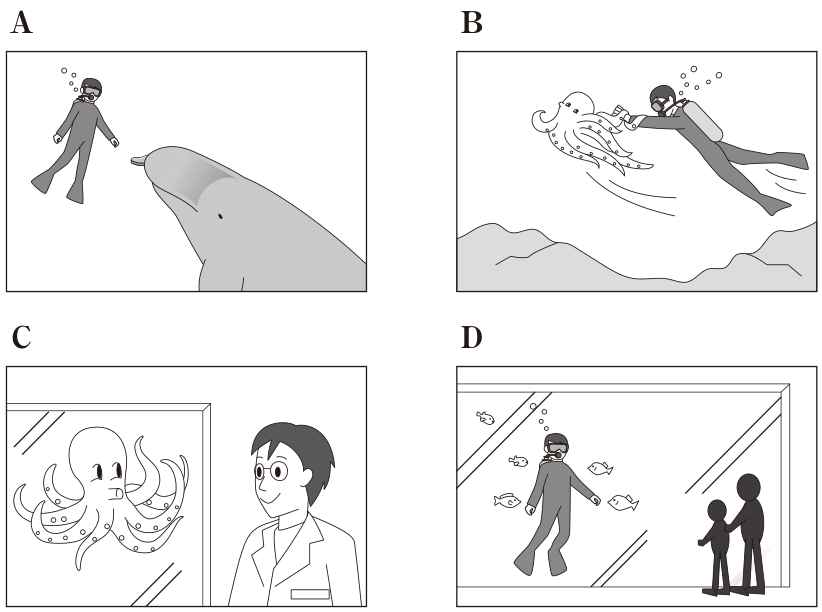
Your quiz question: Which of the following does not represent a story or episode from the article? A B C D Answer [43]

問 1 Choose the best option for [39]. ① a good place where people can interact with octopuses is the ocean ② eye contact is a key sign of friendship between different species ③ interactions with sea creatures can be started by either side ④ people should keep sea creatures at home to make friends with them

問 2 Choose the best options for [40] and [41]. ① be a good source for creating philosophical theories ② be afraid of swimmers when they get close to their home ③ be uncooperative with humans in a laboratory setting ④ compete with other octopuses if they have chances to get treats ⑤ recognize that someone they have met before is kind ⑥ touch, smell, taste, and sense light and color like humans

問 3 Choose the best option for [42]. ① attracting more people with a unique aquarium ② creating a convenient place to swim with sea life ③ raising more intelligent and cooperative octopuses ④ reversing the roles of people and sea creatures

問 4 The answer to your quiz question is [43]. ① A ② B ③ C ④ D

あなたのまとめ: 水生生物を知る 一般情報 筆者が主に言いたいのは、[39]ということである。 人間とタコの交流 Andersonの実験は、タコが[40]できることを示唆している。 Naples Zoological Stationの実験は、タコが[41]できることを示唆している。 Godfrey-Smithの話は、タコが友好的になり得ることを示唆している。 Kahn一家 [42]という考えでCoral Worldを設立した。

あなたのクイズ問題: 次のうち、記事中の話や出来事を表していないものはどれか。 A B C D 答え [43]

問1 [39]に入る最も適切な選択肢を選びなさい。 ① 人々がタコと交流できるよい場所は海である ② 目を合わせることは、異なる種の間の友情の重要な兆候である ③ 海の生き物との交流は、どちらの側からでも始められる ④ 人々は海の生き物と友達になるために、家で飼うべきである

問2 [40]と[41]に入る最も適切な選択肢を選びなさい。 ① 哲学理論を作るためのよい材料になる ② 泳いで近づいてくる人を、住みかの近くで恐れる ③ 研究室で人間に協力しない ④ ごほうびをもらえる機会があれば、ほかのタコと競争する ⑤ 以前会った人が親切だと認識する ⑥ 人間と同じように、触れ、においをかぎ、味を感じ、光と色を感知する

問3 [42]に入る最も適切な選択肢を選びなさい。 ① 独特な水族館でより多くの人を引きつけること ② 海の生き物と泳げる便利な場所を作ること ③ より知的で協力的なタコを育てること ④ 人間と海の生き物の立場を逆転させること

問4 あなたのクイズ問題の答えは[43]である。 ① A ② B ③ C ④ D

Graphene

As you are reading this, you probably have a pencil in your hand. In the center of every pencil is something called “lead.” This dark gray material is not actually lead (Pb), but a different substance, graphite. Graphite has been a major area of research for many years. It is made up of thin layers of carbon that can be easily separated. Indeed, it is this ease of separation that enables the pencil to write. As the pencil rubs against the paper, thin layers of carbon are pulled off the pencil lead and left on the paper as lines or writing.

In 2004, two scientists, Andre Geim and Konstantin Novoselov, were investigating graphite at the University of Manchester, in the UK. They were trying to see if they could obtain a very thin slice of graphite to study. Their goal was to get a slice of carbon which was between 10 and 100 layers thick. Even though their university laboratory had the latest scientific equipment, they made their incredible breakthrough — for what was later to become a Nobel Prize-winning discovery — with only a cheap roll of sticky tape.

グラフェン

これを読んでいる今、おそらくあなたは手に鉛筆を持っているだろう。どの鉛筆の中心にも、「lead」と呼ばれるものが入っている。この暗い灰色の物質は実際には鉛(Pb)ではなく、別の物質である黒鉛だ。黒鉛は長年、主要な研究対象となってきた。黒鉛は、簡単に分離できる薄い炭素の層からできている。実際、この分離のしやすさによって、鉛筆で文字を書くことができる。鉛筆が紙にこすれると、炭素の薄い層が鉛筆の芯からはがれ、線や文字として紙に残る。

2004年、2人の科学者Andre GeimとKonstantin Novoselovは、UKのUniversity of Manchesterで黒鉛を研究していた。彼らは、研究するために黒鉛の非常に薄い一片を取り出せるかどうかを調べようとしていた。目標は、厚さが10層から100層の間の炭素の一片を得ることだった。大学の研究室には最新の科学機器がそろっていたにもかかわらず、彼らは、後にノーベル賞受賞につながる発見となる、驚くべき突破口を、安価な粘着テープ1巻だけで切り開いた。

In a BBC News interview, Professor Geim described their technique. He said that the first step was to put sticky tape on a piece of graphite. Then, when the tape is pulled off, a flake of graphite will come off on the tape. Next, fold the tape in half, sticking the flake onto the other side of the tape. Then pull the tape apart to split the flake. You now have two flakes, roughly half as thick as before. Fold the tape together once more in a slightly different position to avoid having the flakes touch each other. Pull it apart again, and you will now have four thinner flakes than before. Repeat this procedure 10 or 20 times, and you’re left with many very thin flakes attached to your tape. Finally, you dissolve the tape using chemicals so everything goes into a solution.

BBC Newsのインタビューで、Professor Geimは彼らの技術を説明した。最初の手順は、黒鉛の一片に粘着テープを貼ることだと彼は述べた。次にテープをはがすと、黒鉛の薄片がテープに付いてくる。続いて、薄片がテープの反対側に貼り付くように、テープを半分に折る。その後、テープを引き離して薄片を分割する。すると、先ほどのおよそ半分の厚さの薄片が2枚できる。薄片同士が触れないように、少し位置を変えてもう一度テープを折り合わせる。再び引き離すと、今度は先ほどより薄い薄片が4枚できる。この手順を10回か20回繰り返すと、テープに付いた非常に薄い薄片がたくさん残る。最後に、薬品を使ってテープを溶かし、すべてを溶液に入れる。

Geim and Novoselov then looked at the solution, and were surprised to see that the thin flakes were flat and not rolled up — and even more surprised that the flakes were as thin as only 10 layers of graphite. As graphite conducts electricity, it was only a matter of weeks before they were studying whether these thin sheets could be used in computer chips. By 2005, they had succeeded in separating a single layer of graphite. As this does not exist naturally, this new material was given a new name: graphene. Graphene is only one atom thick, and perhaps the thinnest material in the universe. It is one of the few two-dimensional (2D) materials known, and forms a six-sided, honeycomb-patterned structure. In addition, it is possibly the lightest and strongest substance known on earth. It is also excellent at carrying electricity. In fact, at laboratory temperatures (20-25°C), graphene conducts electricity faster than any known substance. This has led to manufacturers investing in further research because graphene-based batteries could last three times longer and be charged five times faster than lithium-ion batteries.

Graphene has been called a super-material because of its amazing properties. It is 1,000 times lighter than paper and close to being totally transparent. It allows 98% of light to pass through it while at the same time it is so dense that even one molecule of helium gas cannot pass through it. It can also convert light into electricity. It is 200 times stronger than steel by weight: So strong in fact, that if you could make a 1 m² sheet of graphene, it would weigh less than a human hair and be strong enough to hold the weight of a cat. Quite simply, this material found in pencil lead has the potential to revolutionize the development of computer chips, rechargeable batteries, and strong, light-weight materials.

その後、GeimとNovoselovは溶液を調べ、薄片が丸まらず平らになっていることに驚いた。そして、薄片が黒鉛わずか10層分の薄さであることには、さらに驚いた。黒鉛は電気を通すため、これらの薄いシートをコンピューターチップに使えるかどうかを研究し始めるまで、わずか数週間しかかからなかった。2005年までに、彼らは黒鉛を1層だけ分離することに成功した。これは自然界には存在しないため、この新しい物質には新しい名前が与えられた。それがグラフェンである。グラフェンは原子1個分の厚さしかなく、おそらく宇宙で最も薄い物質である。これは知られている数少ない二次元(2D)物質の一つで、六角形が連なる蜂の巣状の構造を形成している。さらに、地球上で知られている物質の中で最も軽く、最も強い可能性がある。また、電気を運ぶ性能にも非常に優れている。実際、実験室の温度(20~25°C)では、グラフェンは知られているどの物質よりも速く電気を通す。このことからメーカーはさらなる研究に投資している。グラフェンを使った電池は、リチウムイオン電池の3倍長く使え、5倍速く充電できる可能性があるからだ。

グラフェンは、その驚くべき性質から超物質と呼ばれている。紙より1,000倍軽く、ほぼ完全に透明である。光の98%を通過させる一方で、非常に密度が高いため、ヘリウムガスの分子1個でさえ通り抜けることができない。また、光を電気に変換することもできる。重量あたりでは鋼鉄の200倍強い。実際、非常に強いため、もし1平方メートルのグラフェンのシートを作れたなら、人間の髪の毛より軽いのに、猫の体重を支えられるほどの強度を持つだろう。つまり、この鉛筆の芯に見つかった物質は、コンピューターチップ、充電式電池、強くて軽量な素材の開発に革命を起こす可能性を秘めている。

Your presentation poster draft: Graphene Basic information [44] Graphene... A. is a 2D material. B. is a separated layer of graphite. C. is an extremely thin sheet of metal. D. is not a naturally occurring substance. E. looks like a sheet of wire mesh. F. was isolated without advanced equipment. How Geim and Novoselov separated graphite (5 steps) Step 1. Press sticky tape on graphite and remove. Step 2. [45] Step 3. [45] Step 4. [45] Step 5. Dissolve tape in a chemical solution and collect the flakes. The properties of graphene [46] [47] Future use [48]

問 1 You are checking your poster. You spotted an error in the basic information section. Which of the following should you remove? [44] ① A ② B ③ C ④ D ⑤ E ⑥ F

問 2 You are going to summarize the five-step process used to separate layers of graphite. Choose the best combination of steps to complete the process. [45] A. Do this process over and over again. B. Fold tape in two again so another part of the tape touches the graphite. C. Fold tape in two and pull it apart. D. Place tape on the thinner flakes and press down. E. Pull a flake of graphite off some sticky tape. ① C → B → A ② C → E → D ③ D → C → B ④ D → E → A ⑤ E → C → A ⑥ E → C → D

問 3 From the list below, select the two which best describe graphene’s properties. (The order does not matter.) [46] [47] ① At average room temperature, it is the world’s most efficient material for carrying electricity. ② Gram for gram, graphene is stronger and more resistant to electricity. ③ Graphene weighs slightly more than graphite per cm². ④ It allows almost all light to pass through its structure. ⑤ Its six-sided honeycomb structure allows gas particles to pass from one side to another.

問 4 From this passage, which of the following might graphene be used for in the future? [48] ① A material for filtering small gas molecules from large ones ② Developing light-sensitive chips ③ Electricity resistant materials ④ Increasing the weight and strength of batteries

問 5 From this passage, we can infer that the writer [49]. ① believed that many great Nobel Prize-winning discoveries have been made with low-cost equipment ② knew about the potential of graphene to reduce the production costs and recharging times of rechargeable batteries ③ was impressed by the fact that graphene and all its properties had lain hidden in every pencil mark until being revealed by Geim and Novoselov ④ was surprised at how long it took for Geim and Novoselov to realize the potential of using thin sheets of graphene in computer chips

あなたの発表用ポスターの下書き: グラフェン 基本情報 [44] グラフェンは…… A. 2D物質である。 B. 分離された黒鉛の層である。 C. 非常に薄い金属のシートである。 D. 自然に存在する物質ではない。 E. 金網のシートのように見える。 F. 高度な機器なしで分離された。 GeimとNovoselovが黒鉛を分離した方法(5段階) 手順1。粘着テープを黒鉛に押し付けてはがす。 手順2。[45] 手順3。[45] 手順4。[45] 手順5。テープを薬品の溶液に溶かし、薄片を集める。 グラフェンの性質 [46] [47] 将来の用途 [48]

問1 ポスターを確認している。基本情報の部分に誤りを見つけた。次のうち、どれを削除すべきか。[44] ① A ② B ③ C ④ D ⑤ E ⑥ F

問2 黒鉛の層を分離するために用いられた5段階の手順をまとめようとしている。その手順を完成させるために、最も適切な組み合わせを選びなさい。[45] A. この手順を何度も繰り返す。 B. テープをもう一度2つに折り、テープの別の部分が黒鉛に触れるようにする。 C. テープを2つに折り、引き離す。 D. 薄くなった薄片の上にテープを置き、押し付ける。 E. 粘着テープから黒鉛の薄片を引きはがす。 ① C → B → A ② C → E → D ③ D → C → B ④ D → E → A ⑤ E → C → A ⑥ E → C → D

問3 次のリストから、グラフェンの性質を最もよく表すものを2つ選びなさい。(順序は問わない。)[46][47] ① 平均的な室温では、電気を通す速さが世界で最も高い物質である。 ② 同じ重さで比べると、グラフェンはより強く、電気に対してより抵抗がある。 ③ グラフェンは1平方センチメートルあたり、黒鉛よりわずかに重い。 ④ その構造を通して、ほとんどすべての光を通過させる。 ⑤ 六角形の蜂の巣状構造によって、気体の粒子が一方の側からもう一方の側へ通り抜けられる。

問4 この文章によると、グラフェンは将来、何に使われる可能性があるか。[48] ① 小さな気体分子と大きな気体分子を分けるフィルター材料 ② 光に反応するチップの開発 ③ 電気を通しにくい素材 ④ 電池の重量と強度を増すこと

問5 この文章から、筆者は[49]と推測できる。 ① 多くの偉大なノーベル賞受賞発見は、低価格の機器でなされてきたと考えていた ② グラフェンには、充電式電池の製造費を削減し、充電時間を短縮する可能性があることを知っていた ③ グラフェンとそのすべての性質が、GeimとNovoselovによって明らかにされるまで、すべての鉛筆の線の中に隠れていたことに感銘を受けていた ④ GeimとNovoselovが、グラフェンの薄いシートをコンピューターチップに使う可能性に気づくまで長い時間がかかったことに驚いていた

3

解答解説

設問 1 の解答・解説

Choose the best option for ____.

訳

[39]に入る最も適切な選択肢を選びなさい。

一般情報の要約は、一つの出来事ではなく、クジラが餌を渡したこと、タコが人を見分けること、タコが人を案内したこと、Coral Worldで海の生物が人間を見に来ることをまとめます。共通点は、人間と海の生物の交流が人間側からだけでなく、海の生物側からも始まることです。[39]は③です。

選択肢を比べる

1. a good place where people can interact with octopuses is the ocean

訳

人々がタコと交流できるよい場所は海である

本文には海中での交流だけでなく、Coral Worldの“people tank”のような施設も登場します。交流の場所をthe oceanに限定していません。

2. eye contact is a key sign of friendship between different species

訳

目を合わせることは、異なる種の間の友情の重要な兆候である

タコが視線を返す話はありますが、eye contactが異種間の友情の鍵だとは述べていません。

3. interactions with sea creatures can be started by either side

○ 正解
訳

海の生き物との交流は、どちらの側からでも始められる

クジラが餌を渡し、タコが人を案内し、海の生物が人間を見に来るため、交流はどちら側からも始まり得るとまとめられます。

4. people should keep sea creatures at home to make friends with them

訳

人々は海の生き物と友達になるために、家で飼うべきである

本文は海中観察や飼育下の実験を扱いますが、海の生物を家庭で飼うべきだとは述べていません。

設問 2 の解答・解説

Choose the best options for ____ and ____.

訳

[40]と[41]に入る最も適切な選択肢を選びなさい。

Andersonの実験では、同じ制服の二人でも、餌を与えて交流した人に対する反応が別人への反応と異なりました。そのため[40]は⑤です。Naples Zoological Stationの実験では、AlbertとBertramは協力しましたが、Charlesはレバーを下げず器具を壊したため、[41]は③です。

最初の位置

1. be a good source for creating philosophical theories

訳

哲学理論を作るためのよい材料になる

哲学理論を観察から発展させたのはGodfrey-Smithであり、Andersonの実験の内容ではありません。

2. be afraid of swimmers when they get close to their home

訳

泳いで近づいてくる人を、住みかの近くで恐れる

実験は泳者への恐怖ではなく、同じ制服を着た二人への反応の差を調べています。

3. be uncooperative with humans in a laboratory setting

訳

研究室で人間に協力しない

人間への非協力的な行動はCharlesのレバー実験に対応します。

4. compete with other octopuses if they have chances to get treats

訳

ごほうびをもらえる機会があれば、ほかのタコと競争する

他のタコと餌を争う実験ではなく、二人の人間に対する反応を比較しています。

5. recognize that someone they have met before is kind

○ 正解
訳

以前会った人が親切だと認識する

餌を与え交流した相手への反応が異なったため、以前会った親切な相手を認識する可能性を示します。

6. touch, smell, taste, and sense light and color like humans

訳

人間と同じように、触れ、においをかぎ、味を感じ、光と色を感知する

タコは人間とは異なる方法で光や色を感じると説明されており、人間と同じ感覚だとは述べていません。

最後の位置

1. be a good source for creating philosophical theories

訳

哲学理論を作るためのよい材料になる

哲学理論を発展させた人物はGodfrey-Smithで、Naplesの実験が理論作成の材料になったとは書かれていません。

2. be afraid of swimmers when they get close to their home

訳

泳いで近づいてくる人を、住みかの近くで恐れる

Naplesの実験は泳者への恐怖ではなく、飼育下でレバーを下げて餌を得る課題です。

3. be uncooperative with humans in a laboratory setting

○ 正解
訳

研究室で人間に協力しない

Charlesはレバー操作を拒み、科学者に水をかけて器具を壊しました。人間に協力しない行動です。

4. compete with other octopuses if they have chances to get treats

訳

ごほうびをもらえる機会があれば、ほかのタコと競争する

複数のタコが餌をめぐって競争したのではなく、課題への協力の有無が記されています。

5. recognize that someone they have met before is kind

訳

以前会った人が親切だと認識する

人を見分ける可能性はAndersonの実験の内容で、Naplesのレバー実験の結論ではありません。

6. touch, smell, taste, and sense light and color like humans

訳

人間と同じように、触れ、においをかぎ、味を感じ、光と色を感知する

感覚器官の説明を並べた選択肢で、レバー課題への協力性を表していません。

設問 3 の解答・解説

Choose the best option for ____.

訳

[42]に入る最も適切な選択肢を選びなさい。

Kahn familyは、海の生物を水槽に閉じ込めて人間が見る方式ではなく、人間が“people tank”に入り、自由に泳ぐ魚や海の生物が人間を見に来る方式を作りました。展示する側と展示される側を入れ替えたため、[42]は④です。

選択肢を比べる

1. attracting more people with a unique aquarium

訳

独特な水族館でより多くの人を引きつけること

来場者を引きつける効果は考えられますが、本文の中心は展示する側と見られる側の逆転です。

2. creating a convenient place to swim with sea life

訳

海の生き物と泳げる便利な場所を作ること

海中に建物を作っていますが、便利な遊泳場所を作ることが目的だとは説明されていません。

3. raising more intelligent and cooperative octopuses

訳

より知的で協力的なタコを育てること

タコを訓練して賢く協力的にする施設ではなく、自然に泳ぐ生物と人間が出会う展示です。

4. reversing the roles of people and sea creatures

○ 正解
訳

人間と海の生き物の立場を逆転させること

通常の水族館とは逆に、人間が展示され、海の生物が人間を見に来る仕組みです。

設問 4 の解答・解説

The answer to your quiz question is ____.

訳

あなたのクイズ問題の答えは[43]である。

Question s35 image choices A-D showing whale, octopus, and Coral World scenes

クイズは、本文で実際に語られた特定の物語・出来事を表していない図を選ぶ問題です。AはMcSweeneyとクジラ、BはタコがGodfrey-Smithの同僚を案内した出来事、DはCoral Worldの“people tank”に対応します。Cはタコが人間を見ている一般的な場面で、本文中の独立した物語や実験の一場面としては語られていません。そのため[43]は④です。

選択肢を比べる

1. A

クジラが近づき、McSweeneyにマグロを渡した具体的な経験を表しています。

2. B

タコが人間の手を取り、住みかを10分間案内した出来事に対応します。

3. C

タコが人間を見るという一般的な交流のイメージですが、本文で語られた特定の物語・実験の場面ではありません。

4. D

○ 正解

人間が“people tank”に入り、魚や海の生物が人間を見に来るCoral Worldの説明を表しています。

設問 5 の解答・解説

Which of the following should you remove from the basic information section? ____

訳

基本情報の部分から、次のうちどれを削除すべきか。[44]

ポスターの基本情報から削除すべき内容を選びます。本文はグラフェンを炭素の単一層、二次元素材、蜂の巣状構造、自然には存在しない新素材として説明しています。「金属」という説明は本文にありません。[44]は③です。

選択肢を比べる

1. is a 2D material.

訳

2D物質である。

本文に2D materialsと明記されているため、基本情報に残せます。

2. is a separated layer of graphite.

訳

分離された黒鉛の層である。

黒鉛の単一層を分離して得た素材なので、分離された黒鉛の層という説明は本文に沿います。

3. is an extremely thin sheet of metal.

○ 正解
訳

非常に薄い金属のシートである。

本文はグラフェンを炭素の層として説明しており、金属とは述べていません。

4. is not a naturally occurring substance.

訳

自然に存在する物質ではない。

自然には存在しない新素材だと明記されています。

5. looks like a sheet of wire mesh.

訳

金網のシートのように見える。

六角形の蜂の巣状構造を形成すると説明されています。

6. was isolated without advanced equipment.

訳

高度な機器なしで分離された。

最新設備ではなく、安価な粘着テープが突破口になったと述べています。

設問 6 の解答・解説

Choose the best combination of steps to complete the process. ____

訳

手順を完成させるために、最も適切な組み合わせを選びなさい。[45]

Step 1の後は、まず黒鉛片を折って分割し、その操作を位置を変えながら繰り返します。したがってE→C→Aの順が適切で、[45]は①です。

選択肢を比べる

1. C → B → A

○ 正解
訳

C → B → A

Eで黒鉛片を得て、Cで折って引き離し、Aで同じ操作を繰り返す流れです。

2. C → E → D

訳

C → E → D

Cを先に行うには、すでにテープ上に黒鉛片が必要です。Step 1直後の操作として順序が逆です。

3. D → C → B

訳

D → C → B

Dはテープを黒鉛に押す操作で、Step 1ですでに行われています。

4. D → E → A

訳

D → E → A

Eの後にDを置く根拠がなく、折って分割する中心操作も抜けています。

5. E → C → A

訳

E → C → A

EはStep 1の「テープから黒鉛片を取る」操作と重複します。

6. E → C → D

訳

E → C → D

E→Cまでは合いますが、本文にある10〜20回の反復Aが抜けています。

設問 7 の解答・解説

Select the two which best describe graphene’s properties. ____ ____

訳

グラフェンの性質を最もよく表すものを2つ選びなさい。[46][47]

本文の性質から、[46]は室温での電気伝導性を表す①、[47]は光の透過性を表す④です。グラフェンは強いだけでなく、電気を速く通し、光の98%を通す一方でヘリウム分子を通しません。

組み合わせ(順不同)

1. At average room temperature, it is the world’s most efficient material for carrying electricity.

○ 正解
訳

平均的な室温では、電気を通す速さが世界で最も高い物質である。

20〜25℃で、既知のどの物質より速く電気を伝えると本文にあります。 室温での電気伝導性を述べた選択肢で、光の透過性とは別の性質です。

2. Gram for gram, graphene is stronger and more resistant to electricity.

訳

同じ重さで比べると、グラフェンはより強く、電気に対してより抵抗がある。

strongとは合いますが、resistant to electricityは電気を通しにくい意味になり、本文と逆です。 強度と電気抵抗を組み合わせていますが、本文は電気をよく通すと説明しています。

3. Graphene weighs slightly more than graphite per cm².

訳

グラフェンは1平方センチメートルあたり、黒鉛よりわずかに重い。

本文は紙より1000倍軽いと述べており、黒鉛より少し重いとは言っていません。 本文の重量比較は紙との比較であり、黒鉛より重いとは述べていません。

4. It allows almost all light to pass through its structure.

○ 正解
訳

その構造を通して、ほとんどすべての光を通過させる。

光の透過性の説明であり、電気伝導性を表す選択肢ではありません。 光の98%を通すため、ほぼすべての光を通す説明に合います。

5. Its six-sided honeycomb structure allows gas particles to pass from one side to another.

訳

六角形の蜂の巣状構造によって、気体の粒子が一方の側からもう一方の側へ通り抜けられる。

六角形構造は述べられますが、気体を通すとは逆にヘリウム分子も通しません。 密度が高く、ヘリウム分子さえ通さないため、気体を通すという説明は逆です。

設問 8 の解答・解説

Which of the following might graphene be used for in the future? ____

訳

グラフェンは将来、何に使われる可能性があるか。[48]

本文の「光を電気に変換できる」という性質を、将来の用途へ結び付けます。光を受けて電気信号を作れるなら、光に反応するチップへの応用が考えられるので②です。本文はコンピューターチップの開発への可能性にも触れています。①のフィルターは小さな分子を通して大きな分子と分ける仕組みですが、本文は小さなヘリウムの分子さえ通さないと述べています。「気体を通さない」ことを「大きさによって通し分けられる」ことと混同しないようにします。

選択肢を比べる

1. A material for filtering small gas molecules from large ones

訳

小さな気体分子と大きな気体分子を分けるフィルター材料

小さなヘリウム分子さえ通さないとあるため、小さい分子だけを通して大きな分子と分離できるという用途は、この本文から導けません。

2. Developing light-sensitive chips

○ 正解
訳

光に反応するチップの開発

It can also convert light into electricity が根拠です。光を電気信号に変えられる性質は、光に反応するチップの開発につながります。

3. Electricity resistant materials

訳

電気を通しにくい素材

グラフェンは電気をよく通すため、電気を妨げる材料とは逆の用途です。

4. Increasing the weight and strength of batteries

訳

電池の重量と強度を増すこと

電池は長寿命・急速充電が期待されますが、重量を増やす用途ではなく、軽量で強い材料が期待されています。

設問 9 の解答・解説

From this passage, we can infer that the writer ____.

訳

この文章から、筆者は[49]と推測できる。

筆者は、身近な鉛筆の黒鉛から、極めて薄く、軽く、強く、電気をよく通すグラフェンが得られた経緯を説明しています。そのため、グラフェンの多様な可能性が、GeimとNovoselovによって明らかにされるまで鉛筆の一画の中に隠れていた、という③が本文全体から導けます。[49]は③です。

選択肢を比べる

1. believed that many great Nobel Prize-winning discoveries have been made with low-cost equipment

訳

多くの偉大なノーベル賞受賞発見は、低価格の機器でなされてきたと考えていた

安価なテープで発見できた例はありますが、多くのノーベル賞発見が低価格の器具でなされたという筆者の信念は示されていません。

2. knew about the potential of graphene to reduce the production costs and recharging times of rechargeable batteries

訳

グラフェンには、充電式電池の製造費を削減し、充電時間を短縮する可能性があることを知っていた

電池が3倍長持ちし5倍速く充電できる可能性は述べられますが、研究者がその性能を発見時点で知っていたとは書かれていません。

3. was impressed by the fact that graphene and all its properties had lain hidden in every pencil mark until being revealed by Geim and Novoselov

○ 正解
訳

グラフェンとそのすべての性質が、GeimとNovoselovによって明らかにされるまで、すべての鉛筆の線の中に隠れていたことに感銘を受けていた

鉛筆の芯に使われていた黒鉛から、研究者が分離・命名することで、薄さ・強さ・伝導性などの可能性が明らかになったという流れです。

4. was surprised at how long it took for Geim and Novoselov to realize the potential of using thin sheets of graphene in computer chips

訳

GeimとNovoselovが、グラフェンの薄いシートをコンピューターチップに使う可能性に気づくまで長い時間がかかったことに驚いていた

研究者は比較的早くコンピューターチップへの利用を調べ始めており、可能性に気づくまで長期間かかったとは述べていません。

4

読み方のポイントまとめ

第6問は、海の生物と人間の交流を扱う記事と、黒鉛からグラフェンを分離・研究した記事を材料に、要約、実験手順、性質、用途、本文中の出来事を整理する問題です。前半では、クジラやタコが人間に近づいた複数の例を共通する主張へまとめる力が求められます。後半では、テープを使った分離手順を順序どおりに並べ、数値・比較・否定表現を正確に照合します。

  • 設問と要約欄を先に読み、人物名・実験名・数値などの検索語を本文で探します。
  • 複数の具体例を問う要約では、各例に共通する行動や関係を一段抽象化してまとめます。
  • 実験手順は、動詞と順序に注目して整理します。操作の前提になっている行為を重複させないことが大切です。
  • 科学的性質は、最上級・倍率・割合・否定表現を本文と照合します。似た単語だけで判断せず、方向まで確認します。
  • 図の問題では、図の印象だけでなく、本文中の具体的な人物・施設・出来事と対応させます。

間違えやすいポイント

要約を一つのエピソードだけで判断する。
クジラ、Anderson、Godfrey-Smith、Coral Worldの例に共通する「海の生物側からも交流が始まる」という方向を探します。

Andersonの実験を、制服や視線の実験だと読む。
反応の差を生んだ条件は、片方が餌を与え交流したことです。外見ではなく過去の接触経験に注目します。

Step 1の操作を五段階の後半でもう一度選ぶ。
Step 1ですでにテープを黒鉛に押してはがしているので、その後は折る、引き離す、反復する流れになります。

グラフェンの性質を単語だけで判断する。
faster than any known substance、98%、cannot passのような比較・数値・否定表現を必ず確認します。

図の見た目だけでクイズに答える。
各図を、クジラ、タコの案内、一般的な視線の図、people tankの説明と対応させ、特定の物語かどうかを確認します。

次の問題にも使える読み方

具体例を共通主張にまとめる
複数の人物や出来事が並んだら、細部を一つずつ覚えるだけでなく、「誰が誰に何をしたか」を共通化します。
例:クジラが餌を渡し、タコが人を案内し、海の生物が人間を見に来るなら、「交流は海の生物側からも始まる」と整理できます。

実験を条件・反応・結論に分ける
実験では、誰にどんな条件を与え、どんな反応が出て、何が推測されたのかを分けて読みます。
例:餌を与え交流した人への反応が異なったため、「タコは過去に接した相手を認識する可能性」と判断します。

手順を動詞の列として読む
process問題では、press、pull、fold、repeat、dissolveの順に動作を並べると、組み合わせを素早く除外できます。
例:黒鉛片をテープに取る→折って引き離す→位置を変えて反復する→溶液でテープを溶かす、という流れです。

数値・比較・否定を優先して照合する
科学文では、最上級や倍率、割合、否定表現が選択肢の細かな違いを決めます。
例:「光を通す」ではなく「98%を通す」、「気体を通さない」ではなく「ヘリウム分子も通さない」と確認します。

5

重要語句

aquatic
水生の、水に関する
come charging at
勢いよく〜に向かって来る
recognize A as B
AをBだと認識する
cephalopod
頭足類、タコやイカの仲間
tentacle
触手
sucker
吸盤
manipulate
巧みに動かす、操作する
conduct an experiment
実験を行う
similar-looking
見た目がよく似た
socialize with
〜と交流する、親しく接する
mischievous
いたずら好きな
cooperate with
〜に協力する
refuse to do
〜することを拒む
break the equipment
器具を壊す
come across
偶然出会う、見つける
be impressed by
〜に感銘を受ける
graphite
黒鉛、鉛筆の芯に使われる炭素物質
flake
薄片、薄くはがれた一片
separate A from B
AをBから分離する
honeycomb-patterned
蜂の巣状の模様をした
by weight
重量で比べると
conduct electricity
電気を通す
pass through
〜を通り抜ける